Advanced Learning for Text and Graph Data (ALTEGRAD)
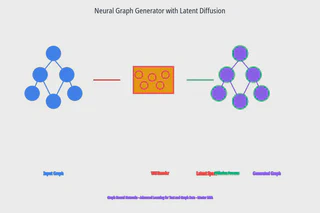 Neural Graph Generator architecture: VAE encoder with SAGEConv, latent diffusion process, and growing MLP decoder for conditional graph generation
This project was conducted as part of the Advanced Learning for Text and Graph Data course in the Master MVA at ENS Paris-Saclay.
The objective of the challenge was to generate graphs with specified structural properties using the Neural Graph Generator (NGG) architecture from Evdaimon et al. (2024), combining a Variational Autoencoder (VAE) for structural encoding and a latent diffusion process for conditional graph generation.
Approach
Our work focused on systematically improving the NGG baseline through controlled experiments on each architectural component:
- Encoder: replaced GIN with SAGEConv, achieving higher accuracy while maintaining stability on small graphs (<50 nodes).
Alternative tests with GAT and TransformerConv confirmed the superiority of SAGEConv. - Decoder: introduced a growing MLP architecture that progressively expands hidden dimensions to match adjacency matrices and injected feature conditioning for better generalization.
- Denoiser: experimented with a 1D-UNet inspired by Stable Diffusion (Rombach et al., 2021) to improve latent denoising, showing strong results albeit high computational cost.
- Training: applied a temperature scheduler for Gumbel-Softmax and fine-tuned β-VAE coefficients for stable convergence.
- Inference: developed a rejection mechanism based on Mean Absolute Error (MAE) between generated and target graph features to select optimal candidates.
Results
| Component | Modification | Impact |
|---|---|---|
| Encoder | GIN → SAGEConv | Improved accuracy and stability |
| Decoder | Growing MLP + feature conditioning | Better reconstruction |
| Denoiser | 1D-UNet prototype | Higher denoising accuracy (non-scalable) |
| Inference | Rejection mechanism (MAE) | Enhanced final score selection |
The final model achieved a MAE of 0.05, ranking 3rd best overall among top French institutions (ENS, École Polytechnique, Ponts, and Dauphine).
This validated the importance of robust conditioning and architectural alignment in graph generation tasks.
References
- I. Evdaimon et al., Neural Graph Generator: Feature-conditioned graph generation using latent diffusion models, 2024.
- R. Rombach et al., High-resolution image synthesis with latent diffusion models, CVPR 2021.