Computational Statistics – Gradient Boosting and Stochastic Sampling
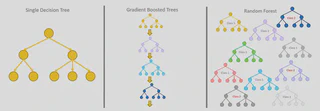 Gradient Boosting ensemble method: combining weak learners (decision trees) into a strong predictor through functional optimization
This project was carried out during the Computational Statistics course taught by Prof. Stéphanie Allassonnière (Sorbonne Université, CNRS) in the Master MVA program at ENS Paris-Saclay.
It combined a theoretical paper presentation and a complete reimplementation of Gradient Boosting as a functional optimization procedure, following Gérard Biau & Benoît Cadre, Optimization by Gradient Boosting (Annals of Statistics, 2021).
Main Project – Functional Gradient Boosting
We implemented Gradient Boosting entirely from scratch, using decision trees as weak learners, to validate the convergence results proven in the reference paper.
The theoretical framework formalizes boosting as an instance of functional gradient descent over the expected loss functional:
Two algorithms were studied:
- Taylor-based functional updates ensuring convergence when the loss satisfies bounded derivative and Lipschitz conditions.
- Regularized updates ensuring avoidance of overfitting in finite-sample regimes.
The final implementation included:
- Tree complexity control scaling as \( \text{max\_depth} \propto \log_2(n) \)
- Regularization term \( \gamma_n = 1/n \)
- Gradient stabilization for convergence to \( F^* \)
Empirical Results:
On the Iris and Wine Quality datasets, our custom implementation achieved accuracy comparable to Scikit-learn’s Gradient Boosting while respecting theoretical convergence bounds.
Secondary Project – Sampling and Stochastic Optimization
In addition to the main project, we explored several computational sampling and optimization techniques relevant to statistical learning:
- Temperature-based sampling for exploring multimodal loss landscapes.
- Stochastic gradient descent variants with adaptive learning rates.
- MALA (Metropolis-Adjusted Langevin Algorithm) sampling for posterior approximation.
- Empirical study of optimal parameter tuning for stability and convergence in noisy gradient regimes.
These complementary experiments provided practical insight into how stochastic optimization interacts with regularization, convergence speed, and model generalization.
References
- G. Biau & B. Cadre (2021). Optimization by Gradient Boosting. Annals of Statistics.
- R. Neal (2011). MCMC Using Hamiltonian Dynamics. Handbook of Markov Chain Monte Carlo.
- S. Allassonnière (2024). Computational Statistics — Lecture Notes, MVA Program.