Probabilistic Graphical Models – Generative vs Discriminative Robustness in Medical Imaging
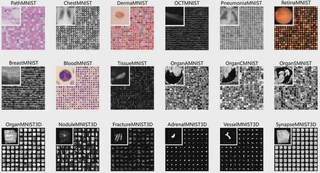 MedMNIST v2: Official dataset overview showing the 18 standardized biomedical image classification datasets used in our comparative study of generative vs discriminative models.
This project was carried out as part of the Probabilistic Graphical Models course taught by Francis Bach at ENS Paris-Saclay within the Master MVA program.
The work focused on exploring whether generative classifiers can offer greater robustness than discriminative ones when applied to medical imaging tasks, particularly under both adversarial and non-adversarial perturbations.
Context and Objective
Inspired by the paper “Are Generative Classifiers More Robust to Adversarial Attacks?” (Li, Bradshaw & Sharma, 2019),
we sought to evaluate and reproduce its conclusions in the context of MRI and CT medical image classification,
where model reliability is crucial due to potential real-world implications of misclassification.
Two models were implemented from scratch:
- Generative Classifier (GBZ model) — modeling the joint distribution \( p(x, y) = p(x|y)p(y) \), trained via VAE-based ELBO.
- Discriminative Classifier (DBX / ResNet18) — modeling \( p(y|x) \), trained for conditional classification.
Both were evaluated for their robustness to adversarial (FGSM, PGD, One-Pixel) and non-adversarial (brightness, contrast) perturbations.
Methodology
Dataset: Medical MNIST (≈50,000 grayscale images, 6 classes — AbdomenCT, BreastMRI, ChestCT, CXR, Hand, HeadCT).
Attacks implemented:
- FGSM (Fast Gradient Sign Method)
- PGD (Projected Gradient Descent)
- One-Pixel black-box perturbation
- Non-adversarial: brightness and contrast changes
Training setup:
- GBZ model trained via ELBO (reconstruction + KL + classification loss)
- ResNet18 fine-tuned on ImageNet weights
- Both models trained for 15 epochs on NVIDIA RTX 4050 GPU
Results
| Attack Type | Metric | ResNet18 (DBX) | GBZ (Generative) |
|---|---|---|---|
| Clean | Accuracy | 0.999 | 0.998 |
| FGSM (ε=0.1) | Accuracy | 0.68 | 0.78 |
| FGSM (ε=0.03) | Accuracy | 0.82 | 0.91 |
| PGD (ε=0.1) | Accuracy | 0.61 | 0.88 |
| One-Pixel | Accuracy | 0.995 | 0.997 |
| Brightness | Accuracy | 0.83 | 0.83 |
| Contrast | Accuracy | 0.73 | 0.88 |
Generative classifiers consistently exhibited higher robustness to both gradient-based and perceptual perturbations.
The results confirm that modeling \( p(x, y) \) rather than \( p(y|x) \) yields better generalization under noisy or corrupted inputs,
especially when data manifolds are complex or multimodal.
Theoretical Framework
The GBZ model introduces a latent variable \( z \) to jointly encode class and feature dependencies:
\[ p(x, z, y) = p(z)p(y|z)p(x|z) \]Training maximizes the Evidence Lower Bound (ELBO):
\[ \mathcal{L} = \mathbb{E}_{q_\phi(z|x)}[\log p_\theta(x|z)] - D_{KL}(q_\phi(z|x) || p(z)) + \mathcal{L}_{class} \]This formulation ensures robust latent representations that better capture intra-class variability.
Analysis and Discussion
- Generative models exhibited smaller accuracy degradation across all tested perturbations.
- Discriminative models, though highly accurate on clean data, were significantly more vulnerable to adversarial gradients.
- Visualizations of the latent space (via PCA) showed that GBZ embeddings maintained strong class separation even after perturbations.
- The One-Pixel attack had negligible effect on both models due to the dataset’s intrinsic class separability.
These findings suggest that generative models provide a natural defense against adversarial instability in high-stakes contexts such as medical imaging.
References
- Li, Y., Bradshaw, J., & Sharma, Y. (2019). Are Generative Classifiers More Robust to Adversarial Attacks?
- Goodfellow, I., Shlens, J., & Szegedy, C. (2015). Explaining and Harnessing Adversarial Examples.
- Kingma, D. P., & Welling, M. (2014). Auto-Encoding Variational Bayes.
- Su, J., Vargas, D. V., & Sakurai, K. (2019). One Pixel Attack for Fooling Deep Neural Networks.
- Tsai, M.-J. et al. (2023). Adversarial Attacks on Medical Image Classification.