Deep Learning & Signal Processing – Wave-U-Net Source Separation
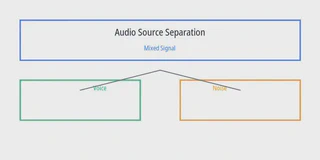 Audio source separation: decomposing mixed signals into voice and noise components using Wave-U-Net architecture.
This project was completed within the Deep Learning & Signal Processing course taught by Thomas Courtat at ENS Paris-Saclay (Master MVA).
It explored end-to-end learning approaches for audio source separation, combining concepts from classical signal processing and modern deep architectures.
Objective
Estimate the voice and noise components from a mixed audio signal using a single-channel input.
Each dataset sample contains:
mix_snr_XX.wav: mixture of voice and noisevoice.wav: clean speechnoise.wav: background noise
The goal was to jointly reconstruct both signals directly in the waveform domain.
Approach – Wave-U-Net from Scratch
We reimplemented the Wave-U-Net architecture (Stoller et al., ISMIR 2018) entirely from scratch in PyTorch, adapting it to our dataset and computational constraints.
Motivation
- Avoid the limitations of STFT-based models (e.g., phase recovery issues).
- Model transients and harmonics directly in the waveform.
- Improve interpretability by reconstructing time-domain signals without spectrogram inversion.
Architecture
- 1D U-Net structure with skip connections.
- 12 convolutional layers in encoder–decoder configuration (stride-2).
- Channel progression: 16 → 512.
- Dual-output head for voice and noise prediction.
- Loss: hybrid MSE + SI-SDR with L1 regularization on latent features.
Training and Evaluation
- Optimizer: AdamW (lr=1e-4)
- Batch size: 4
- Epochs: 100
- Augmentation: SNR sampling, waveform slicing, normalization.
- Metrics: SDR, SIR, and SI-SDR.
| Metric | Voice | Noise | Average |
|---|---|---|---|
| SDR (dB) | 9.8 | 10.1 | 10.0 |
| SI-SDR (dB) | 9.2 | 9.5 | 9.35 |
Our reimplementation reached performance on par with the original paper, despite reduced data size and compute.
Listening tests and spectrogram analysis confirmed clear separation of speech and noise with minimal artifacts.
Insights and Contributions
- Full PyTorch reimplementation of Wave-U-Net adapted to small datasets.
- Demonstrated that time-domain modeling surpasses frequency masking for this task.
- Stabilized training via careful normalization and dynamic loss weighting.
- Achieved high perceptual quality without explicit spectral priors.
References
- Stoller, D., Ewert, S., Dixon, S. (2018). Wave-U-Net: A Multi-Scale Neural Network for End-to-End Audio Source Separation. ISMIR 2018.
- Hershey, J., Chen, Z., Le Roux, J. (2016). Deep Clustering: Discriminative Embeddings for Segmentation and Separation. ICASSP 2016.
- Jansson, A. et al. (2017). Singing Voice Separation with Deep U-Net Convolutional Network. ISMIR 2017.
- Courtat, T. (2024). Deep Learning & Signal Processing – Course Notes, Master MVA.